Home / Computer science / 3-coloring (3COL)
Reduce
… 3SAT to 3COL, showing NP-completeness of the latter.
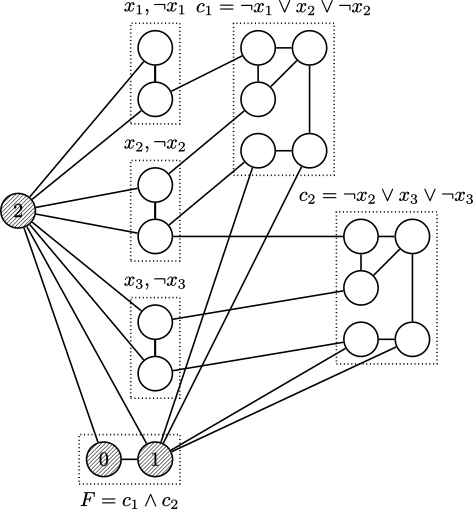
Perform a polynomial-time reduction using the graph below.
- Add three interconnected vertices, colored 1, 2, and 3.
- For each variable, add two uncolored vertices connected to 2.
- For each clause, add one Or gadget connected to:
- the relevant variable vertices and
- the vertex colored 1.
Given
\begin{equation*} F = c_1 \land c_2 \land \cdots = (\ell_{11} \lor \ell_{12} \lor \ell_{13}) \land (\ell_{21} \lor \ell_{22} \lor \ell_{23}) \land \cdots, \end{equation*}connect the graph
\begin{tikzpicture}[thick]

  \usetikzlibrary{fit}
  \usetikzlibrary{patterns}

  % Styles

  \tikzstyle{vertex} = [draw, circle, minimum size = 4ex]

  %%%%%%%%%%%%%%%
  %%% INPUT 1 %%%
  %%%%%%%%%%%%%%%

  % Nodes.

  \node[vertex] (in 1 0) {};
  \node[vertex, below of = in 1 0, node distance = 6ex] (in 1 1) {};

  % Edge.

  \draw (in 1 0) -- (in 1 1);

  % Group

  \node[draw, dotted, fit = (in 1 1) (in 1 0)] {};

  % Notes

  \node[right of = in 1 0, node distance = 8ex] (in 1 0 note) {$x_1$};
  \node[right of = in 1 1, node distance = 8ex] (in 1 1 note) {$\lnot x_1$};

  \draw (in 1 0) -- (in 1 0 note) [dashed];
  \draw (in 1 1) -- (in 1 1 note) [dashed];

  %%%%%%%%%%%%%%%
  %%% INPUT 2 %%%
  %%%%%%%%%%%%%%%

  % Nodes

  \node[vertex, below of = in 1 1, node distance = 9ex] (in 2 0) {};
  \node[vertex, below of = in 2 0, node distance = 6ex] (in 2 1) {};

  % Edge

  \draw (in 2 0) -- (in 2 1);

  % Group

  \node[draw, dotted, fit = (in 2 1) (in 2 0)] {};

  % Notes

  \node[right of = in 2 0, node distance = 8ex] (in 2 0 note) {$x_2$};
  \node[right of = in 2 1, node distance = 8ex] (in 2 1 note) {$\lnot x_2$};
  \draw (in 2 0) -- (in 2 0 note) [dashed];
  \draw (in 2 1) -- (in 2 1 note) [dashed];

  %%%%%%%%%%%%%%%%
  %%% INPUT 3+ %%%
  %%%%%%%%%%%%%%%%

  \node[below of = in 2 1, node distance = 6ex] (in dots) {\vdots};

  %%%%%%%%%%%%%%
  %%% OUTPUT %%%
  %%%%%%%%%%%%%%

  % Nodes

  \node[
    vertex,
    below of = in dots,
    node distance = 8ex,
    pattern=north east lines
  ] (out 1) {1};

  \node[
    vertex,
    left of = out 1,
    node distance = 6ex,
    pattern=north east lines
  ] (out 0) {0};

  % Edge

  \draw (out 0) -- (out 1);

  % Group

  \node[draw, dotted,
  fit = (out 0) (out 1),
  label = below: {$F = c_1 \land c_2 \land \cdots$}
  ] {};

  %%%%%%%%%%%%%%%%%%%%%
  %%% NON-1/0 COLOR %%%
  %%%%%%%%%%%%%%%%%%%%%

  % Node

  \node[vertex, left of = in 2 0, node distance = 12ex, yshift = -3ex, pattern=north east lines] (2) {2};

  % Edges

  \draw
  (2) -- (in 1 0) -- (2) -- (in 1 1)
  (2) -- (in 2 0) -- (2) -- (in 2 1)
  (2) -- (out 0) -- (2) -- (out 1);

  %%%%%%%%%%%%%%%%%%%
  %%% OR GADGET 1 %%%
  %%%%%%%%%%%%%%%%%%%

  % Nodes

  \node[vertex, right of = in 1 0, node distance = 22ex] (or 1 1) {};
  \node[vertex, below of = or 1 1, node distance = 6ex] (or 1 2) {};
  \node[vertex, below of = or 1 2, node distance = 6ex] (or 1 3) {};
  \node[vertex, right of = or 1 1, node distance = 6ex] (or 1 4) {};
  \node[vertex, right of = or 1 3, node distance = 6ex] (or 1 5) {};

  % Edges

  \draw (or 1 4) -- (or 1 2) -- (or 1 1) -- (or 1 4) -- (or 1 5) -- (or 1 3);

  % Group

  \node[draw, dotted,
  fit = (or 1 1) (or 1 2) (or 1 3) (or 1 4) (or 1 5),
  label = {$c_1 = \ell_{11} \lor \ell_{12} \lor \ell_{13}$}
  ] {};

  % Output

  \draw (or 1 3) -- (out 1);
  \draw (or 1 5) -- (out 1);

  % Notes

  \node[left of = or 1 1] (or 1 1 note) {$\ell_{11}$};
  \node[left of = or 1 2] (or 1 2 note) {$\ell_{12}$};
  \node[left of = or 1 3] (or 1 3 note) {$\ell_{13}$};

  \draw (or 1 1) -- (or 1 1 note) [dashed];
  \draw (or 1 2) -- (or 1 2 note) [dashed];
  \draw (or 1 3) -- (or 1 3 note) [dashed];

  %%%%%%%%%%%%%%%%%%%
  %%% OR GADGET 2 %%%
  %%%%%%%%%%%%%%%%%%%

  % Nodes

  \node[vertex, right of = or 1 1, node distance = 22ex] (or 2 1) {};
  \node[vertex, below of = or 2 1, node distance = 6ex] (or 2 2) {};
  \node[vertex, below of = or 2 2, node distance = 6ex] (or 2 3) {};
  \node[vertex, right of = or 2 1, node distance = 6ex] (or 2 4) {};
  \node[vertex, right of = or 2 3, node distance = 6ex] (or 2 5) {};

  % Edges

  \draw (or 2 4) -- (or 2 2) -- (or 2 1) -- (or 2 4) -- (or 2 5) -- (or 2 3);

  % Group

  \node[draw, dotted,
  fit = (or 2 1) (or 2 2) (or 2 3) (or 2 4) (or 2 5),
  label = {$c_2 = \ell_{21} \lor \ell_{22} \lor \ell_{23}$}
  ] {};

  % Output

  \draw (or 2 3) -- (out 1);
  \draw (or 2 5) -- (out 1);

  % Notes

  \node[left of = or 2 1] (or 2 1 note) {$\ell_{21}$};
  \node[left of = or 2 2] (or 2 2 note) {$\ell_{22}$};
  \node[left of = or 2 3] (or 2 3 note) {$\ell_{23}$};

  \draw (or 2 1) -- (or 2 1 note) [dashed];
  \draw (or 2 2) -- (or 2 2 note) [dashed];
  \draw (or 2 3) -- (or 2 3 note) [dashed];

  %%%%%%%%%%%%%%%%%%%%
  %%% OR GADGET 3+ %%%
  %%%%%%%%%%%%%%%%%%%%

  \node[right of = or 2 2, node distance = 14ex] {$\cdots$};

\end{tikzpicture}
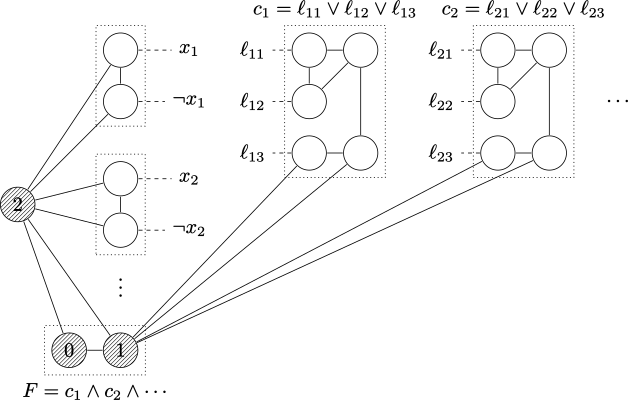
For example,
\begin{equation*} F = (\lnot x_1 \lor x_2 \lor \lnot x_2) \land (\lnot x_2 \lor x_3 \lor \lnot x_3) \end{equation*}reduces to the graph
\begin{tikzpicture}[thick]

  \usetikzlibrary{fit}
  \usetikzlibrary{patterns, positioning}

  % Styles

  \tikzstyle{vertex} = [draw, circle, minimum size = 4ex]

  % Inputs

  \node[vertex] (in x_1) {};
  \node[vertex, below of = in x_1, node distance = 6ex] (in not x_1) {};
  \draw (in not x_1) -- (in x_1);
  \node[draw, dotted, fit = (in x_1) (in not x_1), label = {$x_1, \lnot x_1$}];

  \node[vertex, below of = in not x_1, node distance = 10ex] (in x_2) {};
  \node[vertex, below of = in x_2, node distance = 6ex] (in not x_2) {};
  \draw (in not x_2) -- (in x_2);
  \node[draw, dotted, fit = (in x_2) (in not x_2), label = {$x_2, \lnot x_2$}];

  \node[vertex, below of = in not x_2, node distance = 10ex] (in x_3) {};
  \node[vertex, below of = in x_3, node distance = 6ex] (in not x_3) {};
  \draw (in not x_3) -- (in x_3);
  \node[draw, dotted, fit = (in x_3) (in not x_3), label = {$x_3, \lnot x_3$}];

  % Output

  \node[
    vertex,
    below of = in not x_3,
    node distance = 10ex,
    pattern = north east lines
  ] (out 1) {1};

  \node[
    vertex,
    left of = out 1,
    node distance = 6ex,
    pattern = north east lines
  ] (out 0) {0};

  \draw (out 0) -- (out 1);

  \node[
    draw,
    dotted,
    fit = (out 0) (out 1),
    label = below: {$F = c_1 \land c_2$}
  ];

  % The "2" node.

  \node[
    vertex,
    left of = in not x_2,
    node distance = 16ex,
    yshift = 3ex,
    pattern=north east lines
  ] (2) {2};

  \draw
  (2) -- (in not x_1) -- (2) -- (in x_1)
  (2) -- (in not x_2) -- (2) -- (in x_2)
  (2) -- (in not x_3) -- (2) -- (in x_3)
  (2) -- (out 0) -- (2) -- (out 1);

  % Or 1

  \node[vertex, right of = in x_1, node distance = 12ex] (or 1 1);
  \node[vertex, below of = or 1 1, node distance = 6ex] (or 1 2);
  \node[vertex, below of = or 1 2, node distance = 6ex] (or 1 3);

  \draw (in not x_1) -- (in x_1);
  \draw (in not x_2) -- (in x_2);
  \draw (in not x_3) -- (in x_3);

  \node[vertex, right of = or 1 1, node distance = 6ex] (or 1 4);
  \node[vertex, right of = or 1 3, node distance = 6ex] (or 1 5);

  \draw (or 1 1) -- (or 1 2);
  \draw (or 1 1) -- (or 1 4) -- (or 1 2);
  \draw (or 1 4) -- (or 1 5);
  \draw (or 1 5) -- (or 1 3);

  \node[
    draw,
    dotted,
    fit = (or 1 1) (or 1 2) (or 1 3) (or 1 4) (or 1 5),
    label = {$c_1 = \lnot x_1 \lor x_2 \lor \lnot x_2$}
  ];

  % Or 2

  \node[vertex, right of = in not x_2, node distance = 24ex] (or 2 1);
  \node[vertex, below of = or 2 1, node distance = 6ex] (or 2 2);
  \node[vertex, below of = or 2 2, node distance = 6ex] (or 2 3);

  \draw (in not x_1) -- (in x_1);
  \draw (in not x_2) -- (in x_2);
  \draw (in not x_3) -- (in x_3);

  \node[vertex, right of = or 2 1, node distance = 6ex] (or 2 4);
  \node[vertex, right of = or 2 3, node distance = 6ex] (or 2 5);

  \draw (or 2 1) -- (or 2 2);
  \draw (or 2 1) -- (or 2 4) -- (or 2 2);
  \draw (or 2 4) -- (or 2 5);
  \draw (or 2 5) -- (or 2 3);

  \node[
    draw,
    dotted,
    fit = (or 2 1) (or 2 2) (or 2 3) (or 2 4) (or 2 5),
    label = {$c_2 = \lnot x_2 \lor x_3 \lor \lnot x_3$}
  ];

  % Connect outputs

  \draw (or 1 3) -- (out 1);
  \draw (or 1 5) -- (out 1);
  \draw (or 2 3) -- (out 1);
  \draw (or 2 5) -- (out 1);

  % Connect inputs

  \draw (in not x_1) -- (or 1 1);
  \draw (in x_2) -- (or 1 2);
  \draw (in not x_2) -- (or 1 3);

  \draw (in not x_2) -- (or 2 1);
  \draw (in x_3) -- (or 2 2);
  \draw (in not x_3) -- (or 2 3);

\end{tikzpicture}